
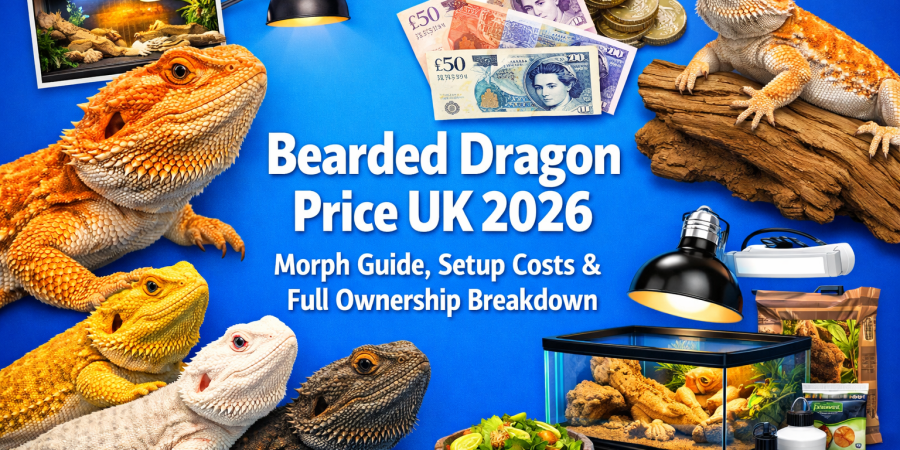
Bearded Dragon Price UK 2026 — Morph Guide, Setup Costs & Full Ownership Breakdown
The Bearded Dragon price UK buyers face in 2026 ranges from £30 for a standard hatchling from a private breeder to £500 or more for a high-end morph with exceptional colour genetics. Unlike many exotic reptiles, Bearded Dragons require no CITES Article 10 certificate, no license and no registration — making them one of the most accessible exotic pets in the UK. This guide covers the Bearded Dragon price UK market by morph, age and source, full setup costs, vivarium equipment, food costs, veterinary expenses and a complete first-year cost breakdown. All pricing data reflects the latest available 2025 UK market data representing current 2026 conditions.
Where to Buy a Bearded Dragon in the UK — Breeder vs Pet Shop vs Rescue
The Bearded Dragon price UK buyers find varies significantly by source — and so does the quality of information, animal health and aftercare support they receive. Understanding the differences between buying channels helps match the right source to your experience level and budget.
Specialist Bearded Dragon breeders are the gold-standard source for most buyers. A specialist breeder works exclusively or primarily with Bearded Dragons, can confirm the genetics and morph status of both parents, will have detailed feeding records for every hatchling and typically offers post-purchase support if husbandry questions arise. The Bearded Dragon price from specialist breeders is 10 to 20 percent higher than private sellers on average, but this premium buys documented lineage, confirmed morph genetics and a well-socialised animal. Reputable breeders in England operating as a business require an Animal Activities License under the 2018 Regulations, which is worth checking before purchasing.
General pet shops offer convenience — Bearded Dragons are visible before purchase and often available without prior arrangement. However, pet shops rarely stock specific morphs in depth, staff expertise in reptile husbandry is variable, and lineage documentation is typically absent. The Bearded Dragon price at pet shops is generally comparable to mid-market private sellers but without the knowledge base a specialist breeder provides.
Reptile expos and specialist reptile fairs — held regularly across the UK including events at the National Motorcycle Museum in Solihull, the Three Counties Showground and similar venues — bring together breeders from across the country in one location. The Bearded Dragon price at expos tends to be competitive, and buyers can compare multiple specimens and breeders in a single visit. However, transport stress can affect animals at expos, and it is worth asking how long the dragon has been at the show before purchasing.
Private rehome platforms — including Petsloo.co.uk, Freeads and private Facebook reptile groups — list Bearded Dragons from owners who can no longer keep them. The Bearded Dragon price on rehome platforms is the lowest of any channel, with many listings including complete vivarium setups at prices of £100 to £300. These animals are typically adults or established juveniles — often well-handled and on a settled diet. The main consideration is confirming health and husbandry history before purchase.
| Buying Channel | Typical Bearded Dragon Price UK | Morph Selection | Documentation | Best For |
|---|---|---|---|---|
| Specialist breeder | £50–£500+ | Excellent — specialist stock | Full morph and lineage info; AAL verified | Morph buyers; first-time owners wanting support |
| General pet shop | £40–£150 | Limited — standard types only | Minimal; breeder unknown | Standard pet buyers; convenience |
| UK reptile expo | £40–£400+ | Very good — many breeders | Variable; ask specifically | Experienced keepers; morph comparison |
| Private rehome (Petsloo, Freeads) | £0–£200 (often with setup) | Variable — whatever is available | Owner’s knowledge only | Budget buyers; those wanting adults |
| Reptile rescue centre | £0–£50 adoption fee | None — rescue stock only | Rescue history notes | Experienced keepers; rehoming focus |
Sources: Pets4Homes Bearded Dragon listing analysis 2025–2026; Freeads UK Bearded Dragon listing analysis 2025; British Pet Insurance bearded dragon guide 2025; Animal Welfare (Licensing of Activities Involving Animals) Regulations 2018.
What to Look for When Buying a Bearded Dragon in the UK — Buyer Checklist
Whatever the Bearded Dragon price UK market is showing — and whatever morph you are considering — conducting a proper pre-purchase health check protects you from taking on a sick or poorly-kept animal. A healthy Bearded Dragon should display a range of physical and behavioural indicators that can be assessed before purchase.
A healthy dragon should have clear, bright eyes without any cloudiness, discharge or sunken appearance. The body should be well-filled with no visible spine or hip bones — a gaunt or bony dragon indicates poor nutrition or illness. The abdomen should be rounded but not bloated. All four limbs should be symmetrical and functional, with no trembling or weakness — trembling limbs are one of the earliest signs of Metabolic Bone Disease. The tail should taper normally with no kinks or deformities. Toes should be intact with no retained shed (dysecdysis) evident around the tips.
Ask the seller to show the dragon eating before purchase if possible. A dragon that refuses all food and appears lethargic at the point of sale may be stressed, newly moved, or unwell. Ask about the feeding history — what insects, what vegetables, at what frequency. Confirm the dragon has been kept on solid substrate rather than loose sand or bark. Ask to see the vivarium setup it has been kept in, including the UVB brand and bulb age. The Bearded Dragon price being asked should reflect the health and husbandry quality on display — a premium Bearded Dragon price is difficult to justify if the seller cannot demonstrate the basic care requirements have been met.
| Check | Healthy Sign | Warning Sign |
|---|---|---|
| Eyes | Clear, bright, open; tracking movement | Sunken, cloudy, discharge, closed in daytime |
| Body condition | Rounded torso; fat reserves visible at tail base | Visible spine, ribs or hip bones; sunken tail base |
| Limbs | Symmetrical; holds body off ground; no trembling | Trembling, bowing, dragging; asymmetry (MBD sign) |
| Tail | Tapers naturally; no kinks or deformity | Kinked, stiff, discoloured or necrotic tip |
| Toes | All intact; no retained shed | Missing tips; retained shed rings (can cause loss) |
| Skin and beard | Clean, hydrated; beard puffs voluntarily | Retained shed; abnormal patches; persistent dark beard |
| Alertness | Active; responsive to movement; basking posture | Persistently lethargic; eyes closed when warm; unresponsive |
| Faeces (if visible) | Well-formed brown stools with white urates | Runny, bloody or absent faeces; orange/yellow urates |
| Feeding record | Eating live food and greens regularly | No confirmed feeding record; seller unsure of diet |
| Seller documentation | AAL number (if business seller); knows morph genetics | Cannot confirm captive-bred origin; no feeding history |
Sources: ExoticDirect bearded dragon costs guide; British Pet Insurance bearded dragon guide 2025; BritExotics UK exotic pet buying guidance.
What Is the Bearded Dragon Price in the UK in 2026?
The Bearded Dragon price UK market in 2026 shows considerable variation based on morph, age, colour intensity and source. Standard (wild-type) hatchlings from private breeders start from £30 to £60 and represent the most affordable entry point. Morph hatchlings — those with specific colour or scale genetics — typically cost £60 to £200. High-end adult morphs from established breeders command £200 to £500 or more.
UK classifieds listings from Freeads and Pets4Homes in late 2025 and early 2026 show standard baby Bearded Dragons selling at £40 to £80, with Hypo Citrus babies at £80 to £100, Zero morphs at £80 to £180, and premium combinations such as Zero Trans Hypo Leatherback at £130 to £180. Adult dragons with full setups included are commonly listed at £150 to £350 on rehome platforms.
| Category | Price Range | Typical Source | Notes |
|---|---|---|---|
| Standard hatchling (6–12 weeks) | £30–£80 | Private breeder / pet shop | Wild-type colouration; most affordable entry point |
| Standard juvenile (3–6 months) | £50–£120 | Private breeder / pet shop | More established; less risk than very young hatchlings |
| Standard adult (12+ months) | £80–£200 | Private rehome / breeder | Often sold with vivarium included |
| Morph hatchling (Hypo / Citrus / Trans) | £60–£200 | Specialist breeder | Single or dual morph combination |
| Premium morph (Zero / Witblits / Wero) | £100–£350 | Specialist breeder | Rare recessive morphs; reduced patterning |
| High-end combination morph | £200–£500+ | Established specialist | Multi-morph combinations; e.g. Hypo Trans Leatherback Zero |
| Rescue / rehome | £0–£50 | Rescue centres, private rehome | Often includes setup; may need rehabilitation |
| Complete setup package (dragon + viv) | £150–£400 | Private rehome | Significant saving on setup cost |
Sources: Pets4Homes Bearded Dragon listings 2025–2026; Freeads UK Bearded Dragon listings 2025–2026; British Pet Insurance bearded dragon cost guide 2025; ExoticDirect bearded dragon costs guide.
Bearded Dragon Morph Price Guide UK 2026
The morph market is the single biggest driver of Bearded Dragon price variation in the UK. A morph refers to a genetic variation that affects the dragon’s colour, scale texture or patterning. Unlike the CITES-protected species covered elsewhere on Petsloo, Bearded Dragon morphs carry no legal documentation requirements — their value is determined purely by genetics, rarity and colour expression.
The most common morphs in the UK market are Hypo (reduced dark pigmentation, making colours appear more vibrant), Citrus (enhanced yellow-orange colouration), Trans or Translucent (semi-transparent scales creating unique visual effects), Leatherback (reduced scale size for a smoother texture — a co-dominant trait that displays in every dragon that carries it), Zero (near-complete absence of pattern — recessive), Witblits (pale, washed-out colouration — recessive) and Wero (a Zero crossed with Witblits — recessive). These morphs can be combined, with each additional morph typically adding £30 to £100 to the base price of the animal.
| Morph | UK Hatchling Price | UK Adult Price | Key Trait | Rarity in UK |
|---|---|---|---|---|
| Standard (wild-type) | £30–£60 | £60–£150 | Brown/tan natural colouration | Very common |
| Hypo (Hypomelanistic) | £60–£100 | £80–£200 | Reduced dark pigmentation; brighter colours | Common |
| Citrus | £60–£100 | £80–£180 | Enhanced yellow-orange colouration | Common |
| Trans (Translucent) | £80–£150 | £100–£250 | Semi-transparent scales; dark eyes | Moderate |
| Leatherback | £80–£150 | £100–£250 | Reduced scale size; smoother texture; enhanced colour | Moderate |
| Hypo Citrus (dual morph) | £80–£130 | £100–£250 | Combines reduced pigment with vibrant citrus colour | Common |
| Zero | £80–£180 | £120–£300 | Near-absence of pattern; pale silver-grey | Moderate |
| Witblits | £100–£180 | £120–£280 | Washed-out, earthy pale tones; no pattern | Moderate |
| Wero (Zero x Witblits) | £120–£250 | £150–£400 | Combination of Zero and Witblits; very pale | Uncommon |
| Dunner | £100–£200 | £150–£350 | Unique scale arrangement; scattered spotting pattern | Uncommon |
| G-Stripe (Genetic Stripe) | £100–£200 | £150–£350 | Pale dorsal stripe running length of body | Uncommon |
| Multi-morph combination (3+) | £130–£350 | £200–£500+ | E.g. Hypo Trans Leatherback Zero; complex genetics | Rare |
Sources: Pets4Homes morph listings analysis 2025–2026; Freeads UK morph pricing 2025; British Pet Insurance bearded dragon cost guide; ExoticDirect bearded dragon costs guide.
Do Bearded Dragons Require a License or CITES Certificate in the UK?
No. Bearded Dragons (Pogona vitticeps) are not listed under CITES, the Dangerous Wild Animals Act 1976 or any other UK licensing legislation. They are legally sold, bought and kept without any government permit, certificate or registration. This is a significant advantage over species such as African Grey Parrots or Hermann Tortoises, where Article 10 certificates are mandatory for every sale.
The only UK legislation relevant to Bearded Dragon keeping is the Animal Welfare Act 2006, which applies to all animals and requires owners to meet the five welfare needs: a suitable environment, a suitable diet, the ability to exhibit normal behaviour, company of their own kind where appropriate, and protection from pain, suffering, injury and disease. Sellers operating as a business in England also require an Animal Activities License from their local authority under the Animal Welfare (Licensing of Activities Involving Animals) Regulations 2018.
All Bearded Dragons sold in the UK should be captive-bred — importing wild-caught specimens is heavily restricted and any seller who cannot confirm captive-bred origin should be avoided. Captive-bred Bearded Dragons are better adapted to life in captivity, less stressed by handling and less likely to carry parasites than wild-caught individuals.
What Does a Bearded Dragon Vivarium Setup Cost in the UK?
The vivarium setup is consistently the largest single cost for new Bearded Dragon owners — typically exceeding the Bearded Dragon price itself at the budget end of the market. British Pet Insurance’s bearded dragon cost guide prices a full new vivarium setup at £350 to £400 for a 4ft x 2ft x 2ft wooden vivarium with heat lamp, UVB lighting, thermostat, substrate and hide. ExoticDirect puts the average new vivarium setup at around £200, though this reflects older pricing; current 2025–2026 UK retail prices for a quality full setup sit closer to £250 to £450.
A 4ft x 2ft x 2ft (122 x 61 x 61 cm) wooden vivarium is the recommended minimum for an adult Bearded Dragon, according to David Alderton, editor of Practical Reptile Keeping, as cited by ExoticDirect. Hatchlings can be started in a smaller vivarium but will need upgrading within the first year as they grow rapidly — adults reach 40 to 60 cm in length.
| Item | New Price Range | Second-Hand Range | Notes |
|---|---|---|---|
| Wooden vivarium (4ft x 2ft x 2ft) | £80–£200 | £30–£80 | Wooden vivariums retain heat better than glass; minimum adult size |
| T5 UVB lighting kit (Arcadia D3+ 12%) | £50–£120 | £20–£50 | Replace bulb every 6–12 months; T5 is preferred over compact bulbs |
| Basking lamp and ceramic holder | £15–£35 | £5–£15 | 100–150W halogen or mercury vapour bulb for hot spot |
| Thermostat (dimming or on/off) | £25–£60 | £10–£25 | Essential — prevents overheating; dimming type preferred |
| Digital thermometer (dual probe) | £10–£25 | £4–£10 | Monitor hot end (40–43°C) and cool end (22–26°C) simultaneously |
| Substrate (reptile sand mat / tiles / lino) | £10–£30 | £4–£12 | Solid surface substrate recommended for juveniles; avoid loose sand |
| Hides (warm side and cool side) | £10–£25 | £4–£10 | At least two hides; replicate natural shelter behaviour |
| Basking platform / rock | £10–£30 | £4–£12 | Raises dragon closer to basking lamp; slate tiles work well |
| Food and water dishes | £5–£15 | £2–£6 | Separate bowls for greens and live food |
| Calcium and vitamin supplements | £10–£20 | — | Essential — dust live food before every feed |
| Decorations and enrichment | £10–£30 | £4–£12 | Branches, artificial plants; optional but beneficial for wellbeing |
| Total new vivarium setup | £235–£590 | £87–£232 | Full adult-size setup; lower end is minimal, upper end is quality build |
Sources: British Pet Insurance bearded dragon cost guide 2025; ExoticDirect bearded dragon costs guide; Northampton Reptile Centre vivarium pricing (referenced by ExoticDirect); Evolution Reptiles vivarium running cost guide.
What Does It Cost to Feed a Bearded Dragon in the UK?
Bearded Dragons are omnivores whose dietary needs change significantly as they age. Hatchlings and juveniles require a protein-heavy diet — live insects should comprise approximately 80 percent of their food intake, with vegetables making up the remaining 20 percent. This ratio reverses in adults: mature Bearded Dragons should eat approximately 80 percent fresh vegetables and greens with only 20 percent live food. Getting this balance wrong in either direction is a common cause of health problems, particularly obesity in adults fed too many insects, and growth problems in juveniles not given enough protein.
The most commonly fed live insects in the UK are brown crickets, black crickets, locusts, dubia roaches and calci worms. Crickets are the most widely available and affordable, with 250 brown crickets available from UK reptile suppliers for approximately £2.09. Locusts cost slightly more per unit but are nutritionally excellent. Waxworms are a high-fat treat that should be given only occasionally. All live food should be dusted with calcium supplement before every feed, and gut-loaded with nutritious food for 24 hours before being offered to the dragon.
| Food Type | Unit Cost | Monthly Cost (juvenile) | Monthly Cost (adult) | Notes |
|---|---|---|---|---|
| Brown / black crickets | £2.09 per 250 | £15–£25 | £5–£10 | Staple live food; widely available; gut-load before feeding |
| Locusts | £2.50–£4 per 30 | £10–£20 | £4–£8 | Excellent nutrition; preferred by many keepers |
| Dubia roaches | £4–£8 per 50 | £8–£15 | £3–£6 | High protein; longer lived than crickets; less smell |
| Calci worms (Black Soldier Fly larvae) | £2–£3 per 250 | £4–£8 | £2–£4 | High calcium; good for regular supplementation |
| Waxworms | £2.79 per 15g | £3–£5 (occasional) | £2–£4 (occasional) | High fat treat only; maximum 2–3 per week |
| Fresh leafy greens and vegetables | £1–£3 per week | £5–£10 | £8–£15 | Rocket, watercress, butternut squash, bell peppers; daily for adults |
| Calcium supplement (Nutrobal / ReptoCalcium) | £8–£15 per tub | £3–£5 | £2–£4 | Dust all live food; essential to prevent metabolic bone disease |
| Multivitamin supplement | £8–£15 per tub | £2–£4 | £2–£3 | Use 2–3 times per week in addition to calcium |
| Monthly food total | — | £50–£92 | £28–£54 | Juvenile cost higher due to greater live food consumption |
Sources: British Pet Insurance bearded dragon food cost guide 2025; ExoticDirect bearded dragon costs guide; Reptile Forum UK live food pricing; Oreate AI UK bearded dragon cost guide December 2025.
What Does Electricity Cost for a Bearded Dragon Vivarium in the UK?
Running a Bearded Dragon vivarium involves continuous electricity use for heating and UVB lighting, typically for 10 to 14 hours per day. A 4ft vivarium with a 150W basking lamp and a T5 UVB tube running 12 hours daily consumes approximately 1.5 to 2 kWh per day. At the UK average electricity rate of approximately 24p per kWh in 2026, this equates to roughly £11 to £14 per month in electricity costs — significantly higher than the 2012 estimate of £4 per month cited by ExoticDirect, reflecting UK energy price increases since that data was published.
Using a quality thermostat reduces electricity consumption significantly by cutting power to the basking lamp when the set temperature is reached, rather than running it continuously. Evolution Reptiles’ vivarium cost guide confirms that a good thermostat can meaningfully reduce running costs while also protecting the dragon from overheating.
What Are the Annual Running Costs of a Bearded Dragon in the UK?
Annual Bearded Dragon running costs in the UK typically fall between £600 and £1,200 depending on the dragon’s age, whether it is still a juvenile requiring more live food, and the level of veterinary care. This makes the Bearded Dragon one of the more affordable medium-maintenance exotic pets in the UK market.
| Cost Category | Annual Cost (Juvenile) | Annual Cost (Adult) | Notes |
|---|---|---|---|
| Live food (crickets, locusts, roaches) | £360–£720 | £120–£288 | Juveniles eat significantly more live food than adults |
| Fresh vegetables and greens | £60–£120 | £96–£180 | Adults eat more veg daily; juveniles eat less |
| Calcium and vitamin supplements | £36–£72 | £24–£48 | Dust all live food; essential ongoing cost |
| Electricity (heating + UVB) | £132–£168 | £132–£168 | Based on 12 hrs/day at 24p per kWh; varies by tariff |
| UVB bulb replacement | £20–£50 | £20–£50 | Replace every 6–12 months regardless of visible output |
| Substrate replacement | £20–£40 | £20–£40 | Regular partial replacement; full replacement annually |
| Annual vet check | £50–£100 | £50–£100 | Reptile specialist vet; not all practices see bearded dragons |
| Insurance | £48–£120 | £48–£120 | British Pet Insurance from £8.25/month; ExoticDirect also available |
| Miscellaneous (cleaning, enrichment) | £30–£60 | £30–£60 | Disinfectant, replacement hides, enrichment items |
| Annual total | £756–£1,450 | £540–£1,054 | Juvenile cost is higher due to greater live food requirement |
Sources: British Pet Insurance bearded dragon cost guide 2025; ExoticDirect bearded dragon costs guide; Oreate AI UK bearded dragon ownership cost December 2025; Evolution Reptiles vivarium electricity guide; UK average electricity rate 2026.
How Much Does Bearded Dragon Insurance Cost in the UK?
Bearded Dragon insurance is available from specialist exotic pet insurers in the UK. British Pet Insurance offers policies from £8.25 per month, making it one of the most affordable options for reptile cover. ExoticDirect also covers Bearded Dragons under their exotic reptile policies. Insurance is recommended given that reptile specialist vet fees can escalate rapidly — a single emergency consultation and treatment for conditions such as metabolic bone disease or impaction can cost £150 to £500 or more.
| Policy Level | Monthly Premium | Annual Cost | Cover Level | Provider |
|---|---|---|---|---|
| Basic cover | £8–£12 | £96–£144 | Death and theft; limited vet fees | British Pet Insurance / ExoticDirect |
| Standard vet fee cover | £12–£18 | £144–£216 | Up to £1,000–£2,500 vet fees | British Pet Insurance / ExoticDirect |
| Comprehensive cover | £18–£25 | £216–£300 | Up to £5,000 vet fees; death; theft | British Pet Insurance |
Sources: British Pet Insurance bearded dragon insurance page 2025; ExoticDirect reptile insurance; British Pet Insurance cost of owning a bearded dragon guide.
What Are the Most Common Health Problems in Bearded Dragons in the UK?
Bearded Dragons are generally robust when kept correctly, but several health conditions arise regularly in the UK hobby — almost all of them preventable through correct husbandry. The most significant preventable condition is Metabolic Bone Disease (MBD), caused by inadequate UVB lighting and calcium deficiency. It is extremely common in young Bearded Dragons that have been kept without proper UVB lighting or without calcium supplementation on their food. Early signs include trembling, limb deformity and soft jaw — all are warning signs requiring urgent veterinary attention.
Impaction is another serious and unfortunately common condition — it occurs when the dragon ingests loose substrate such as sand, gravel or bark chippings, which accumulate in the gut and cannot be passed. It is entirely preventable by using solid substrate — reptile carpet, lino, ceramic tiles or slate — rather than any loose particulate material. Impaction treatment requires veterinary intervention and can cost £150 to £400 depending on severity.
| Condition | Primary Cause | Symptoms | Treatment Cost |
|---|---|---|---|
| Metabolic Bone Disease (MBD) | Inadequate UVB; calcium deficiency | Trembling, soft bones, limb deformity, soft jaw | £80–£300+ (ongoing management) |
| Impaction | Ingestion of loose substrate (sand, bark) | Lethargy, no defecation, bloated abdomen, paralysis | £100–£400 (vet treatment required) |
| Respiratory infection | Temperatures too low; incorrect humidity | Wheezing, mucus, open-mouth breathing, lethargy | £80–£300 |
| Atadenovirus (Adenovirus) | Viral infection; highly contagious between dragons | Seizures, head tilting, star-gazing, neurological signs | £150–£500+ (management only) |
| Yellow Fungus Disease | Fungal infection (Nannizziopsis guarroi) | Yellow/brown skin lesions; necrosis of tissue | £200–£600+ (often fatal) |
| Coccidia | Parasitic infection; common in hatchlings | Diarrhoea, weight loss, lethargy | £60–£200 (faecal test + treatment) |
| Dysecdysis (retained shed) | Low humidity during shedding; nutritional deficiency | Retained skin on toes, tail tip, eyes | £40–£100 if vet required |
| Brumation (not an illness) | Natural winter slowdown; may alarm new owners | Reduced activity, hiding, reduced appetite in winter | £0 — natural behaviour; vet check advisable |
Sources: BritExotics UK exotic pet guide; ExoticDirect reptile health guides; The Vet Desk bearded dragon cost guide 2026; British Pet Insurance bearded dragon guide 2025.
What Is the First-Year Cost of Owning a Bearded Dragon in the UK?
The first year is the most expensive year of Bearded Dragon ownership for most buyers. Vivarium setup is a one-off cost paid in year one, and juvenile dragons eat more live food than adults, pushing food costs higher. A buyer purchasing a standard hatchling with a basic new setup should budget approximately £400 to £800 all-in for the first year. A buyer choosing a premium morph with a full quality vivarium setup should budget £600 to £1,400 or more.
| Cost Category | Lower Estimate | Upper Estimate | Notes |
|---|---|---|---|
| Purchase price (standard hatchling) | £30 | £350 | Standard baby to premium morph |
| Vivarium (4ft wooden) | £80 | £200 | Adult-size vivarium from the start saves upgrading cost |
| UVB lighting kit | £50 | £120 | T5 Arcadia D3+ 12% recommended |
| Basking lamp and thermostat | £30 | £80 | 150W halogen plus dimming thermostat |
| Thermometer, substrate, hides, dishes | £30 | £75 | All essential items bundled |
| Decorations and enrichment | £10 | £30 | Branches, slate tiles, basking platform |
| First vet check | £50 | £100 | Health check with reptile specialist vet |
| Annual food (juvenile — high live food) | £480 | £864 | Based on monthly totals of £40–£72; higher in first year as juvenile |
| Calcium and vitamin supplements (annual) | £36 | £72 | Essential ongoing supplementation |
| Electricity (annual) | £132 | £168 | 12 hrs/day heating and UVB |
| Insurance (first year) | £96 | £216 | Basic to comprehensive cover |
| Emergency reserve (recommended) | £100 | £200 | Reptile emergencies escalate quickly |
| First year total (including purchase) | £1,124 | £2,475 | Standard hatchling to premium morph; basic to quality setup |
| First year total (excluding purchase) | £1,094 | £2,125 | Setup and running costs only |
Sources: British Pet Insurance bearded dragon cost guide 2025; ExoticDirect bearded dragon costs guide; Pets4Homes and Freeads UK pricing analysis 2025–2026; Oreate AI UK bearded dragon cost guide December 2025.
Bearded Dragon Price UK — Is It a Good Beginner Reptile?
Bearded Dragons are consistently recommended as one of the best starter reptiles available in the UK. Their docile temperament, tolerance for handling, robust nature and relatively straightforward care requirements make them more accessible than chameleons, large snakes or water dragons. The Bearded Dragon price at the standard end of the market — £30 to £80 for a hatchling — is among the lowest of any pet reptile, though the vivarium setup cost makes the true first-year investment significantly higher.
The key commitment a prospective buyer needs to assess is daily live food provision for juveniles. Young Bearded Dragons need to be fed live insects two to three times per day — this is non-negotiable for healthy growth. Owners who cannot commit to sourcing, maintaining and feeding live insects daily should consider an adult dragon, which requires live food only two to three times per week with daily fresh vegetables making up the majority of the diet.
Bearded Dragons also undergo a natural winter slowdown called brumation, which often alarms first-time owners. During brumation — typically October to February in the UK — dragons may hide, eat very little and sleep for extended periods. This is normal and not a cause for concern in an otherwise healthy dragon, though a vet check before the brumation period is advisable for new owners wanting reassurance.
Frequently Asked Questions — Bearded Dragon Price UK 2026
The questions below address the most common queries about the Bearded Dragon price UK buyers search for before purchasing their first dragon. From morph pricing to setup costs and licensing, the answers cover every aspect of the Bearded Dragon price UK picture for 2026. This includes the Bearded Dragon price UK difference between morphs, sources and age groups.
How much does a Bearded Dragon cost in the UK in 2026?
The Bearded Dragon price UK range in 2026 is £30 to £500 or more depending on morph, age and source. Standard hatchlings from private breeders cost £30 to £80. Morph hatchlings cost £60 to £200. Premium multi-morph combinations from specialist breeders cost £200 to £500 or more. Adults sold with vivarium setups are commonly listed at £150 to £350 on UK rehome platforms.
Do Bearded Dragons need a license in the UK?
No. Bearded Dragons are not listed under CITES, the Dangerous Wild Animals Act or any other UK licensing legislation. No permit, certificate or registration is required to buy, own or sell a Bearded Dragon in the UK. The only legal obligation is to meet the Animal Welfare Act 2006 requirements for the five welfare needs of any animal in your care.
What is the cheapest Bearded Dragon morph in the UK?
Standard wild-type Bearded Dragon hatchlings are the most affordable, available from £30 to £60 from private UK breeders. Single morphs such as Hypo or Citrus typically start from £60 to £80. The more morphs combined in one animal, the higher the price — a three or four morph combination will typically cost £130 to £350 as a hatchling.
How much does a Bearded Dragon vivarium setup cost in the UK?
A full new adult-size Bearded Dragon vivarium setup costs £235 to £590 in the UK in 2026, including a 4ft wooden vivarium, T5 UVB lighting, basking lamp, thermostat, thermometer, substrate, hides and dishes. A basic second-hand setup can be found for £87 to £232. Many private sellers list their dragon with a complete setup included, which can represent a significant saving.
How much does it cost to feed a Bearded Dragon per month in the UK?
Monthly food costs are £50 to £92 for a juvenile dragon (which requires more live food) and £28 to £54 for an adult. The difference reflects the dietary shift in adults toward fresh vegetables rather than live insects. These costs include live food, fresh vegetables, calcium supplements and vitamins.
How long do Bearded Dragons live?
Bearded Dragons typically live 10 to 15 years in captivity with proper care. This makes them a medium-term commitment — longer than a dog in many cases. A Bearded Dragon purchased today should still be with you in the mid-2030s with proper husbandry.
What is the annual cost of owning a Bearded Dragon in the UK?
Annual Bearded Dragon running costs in the UK range from approximately £540 to £1,054 for an adult dragon. Juvenile dragons cost more annually — £756 to £1,450 — due to their significantly higher live food requirements. After the first year, costs reduce as the dragon matures and transitions to a more vegetable-heavy diet.
Are Bearded Dragons good pets for children?
Yes, with appropriate supervision. Bearded Dragons are widely regarded as one of the most child-friendly reptile species due to their docile nature and tolerance for handling. However, all reptiles carry a small risk of Salmonella bacteria — children should always wash hands thoroughly after handling. The responsibility for daily live food provision and vivarium maintenance should rest with an adult, not the child.
Where can I find Bearded Dragons for sale in the UK?
Bearded Dragons are available from private breeders, specialist reptile shops, reptile expos and on classifieds platforms including Petsloo.co.uk, Pets4Homes and Freeads. Always purchase from a seller who can confirm the dragon is UK captive-bred, is feeding well, and comes with details of the parents’ morphs if buying for colour genetics. Petsloo.co.uk lists Bearded Dragon and reptile listings from sellers across all four UK nations.
What is the Bearded Dragon price UK difference between pet shops and breeders?
Pet shop Bearded Dragons typically cost 10 to 20 percent more than equivalent animals from private breeders, who sell directly without retail overhead. However, breeders can often provide more detailed information about the dragon’s lineage, morph genetics and diet history — which matters particularly if you are buying for specific morph traits. For standard dragons, buying from a reputable private breeder typically offers the best combination of price and information.
Bearded Dragon Price UK — What Factors Affect the Cost Most?
Understanding what drives the Bearded Dragon price UK buyers encounter helps assess whether a given asking price represents genuine value. Five key factors account for most of the price variation in the UK market.
Morph genetics is the single largest driver of Bearded Dragon price in the UK. A standard wild-type dragon and a multi-morph combination of the same age, from the same breeder, can differ in price by £200 to £400. This reflects the additional cost the breeder incurs in maintaining specialist breeding pairs, the lower clutch yields from rarer morph pairings, and the genuine market demand for visually striking animals. For buyers who simply want a healthy, handleable pet, a standard or single-morph dragon offers the best Bearded Dragon price value.
Age affects Bearded Dragon price in two directions. Hatchlings are cheapest at point of purchase but come with higher ongoing costs due to their live food requirements, and carry slightly more health risk than established juveniles. Adult dragons cost more to buy but their annual running costs are lower, and their temperament and health status are already established. For first-time owners, a juvenile of 3 to 6 months — past the most vulnerable hatchling stage but still young enough to bond well — often represents the best balance of Bearded Dragon price and suitability.
Source significantly affects both the Bearded Dragon price and the quality of the animal. Specialist breeders who focus exclusively on Bearded Dragons typically charge 10 to 20 percent more than general pet shops but provide detailed lineage information, confirmed morph genetics, known diet history and often ongoing support. Rescue and rehome dragons offer the lowest Bearded Dragon price entry point but may require more patience during settling-in and are less suitable for first-time reptile owners.
Bearded Dragon Price UK — Buying With a Complete Setup vs Buying Separately
One of the most practical decisions for a new Bearded Dragon buyer in the UK is whether to buy the dragon separately and source a new vivarium setup, or to purchase a dragon and complete setup together from a private seller. The Bearded Dragon price for a rehome package — dragon plus full vivarium equipment — is typically £150 to £350, which compares very favourably with the £235 to £590 cost of a new vivarium setup alone.
The risk of buying a second-hand setup is that equipment may be at the end of its effective life. UVB bulbs degrade invisibly — a bulb that appears to be working may be providing inadequate UV output if it is more than 12 months old. Any UVB bulb acquired second-hand should be replaced immediately as a matter of course, at a cost of £20 to £50. Thermostats and temperature controllers should be tested carefully before use. The vivarium itself — if it is wooden and in good structural condition — should be safe to use after a thorough clean with reptile-safe disinfectant.
| Option | Dragon Cost | Setup Cost | Total First-Year Cost | Pros | Cons |
|---|---|---|---|---|---|
| New standard dragon + new setup | £30–£80 | £235–£590 | £1,060–£2,090 | All equipment new; known condition; full control | Higher upfront cost; more decisions to make |
| New morph dragon + new setup | £100–£500 | £235–£590 | £1,130–£2,590+ | Premium genetics; new equipment | Highest initial Bearded Dragon price investment |
| Rehome dragon + complete setup | £0–£50 | £150–£350 (bundled) | £940–£1,870 | Significant saving; dragon may already be settled | Equipment age unknown; dragon history unknown |
| Rehome dragon + replace UVB bulb only | £0–£50 | £150–£350 + £25–£50 | £960–£1,920 | Best value; responsible rehoming | Replace bulb immediately regardless of age |
Sources: Freeads UK rehome listings analysis 2025–2026; ExoticDirect vivarium setup costs; Evolution Reptiles UVB replacement guidance.
Bearded Dragon vs Other Beginner Reptiles — UK Cost Comparison 2026
The Bearded Dragon price UK market positions the species competitively against other beginner reptiles. While the purchase price is comparable to Leopard Geckos and Corn Snakes, the Bearded Dragon’s higher live food requirements and larger vivarium make it a costlier species to run on an annual basis. However, its unmatched sociability and tolerance for handling justify that premium for most buyers.
| Species | Purchase Price | New Setup Cost | Annual Running Cost | CITES / License | Beginner Suitability |
|---|---|---|---|---|---|
| Bearded Dragon (standard) | £30–£80 | £235–£590 | £540–£1,054 (adult) | None required | Excellent — most handleable reptile |
| Leopard Gecko | £30–£150 | £100–£300 | £300–£700 | None required | Excellent — nocturnal; smaller setup |
| Corn Snake | £20–£80 | £100–£250 | £200–£500 | None required | Good — minimal handling initially |
| Ball Python | £30–£200 | £150–£400 | £300–£700 | None required | Good — docile but requires frozen mice |
| Crested Gecko | £30–£150 | £80–£200 | £200–£500 | None required | Good — no live food if using Crested Gecko Diet |
| Blue-Tongued Skink | £80–£200 | £150–£400 | £400–£800 | None required | Good — omnivore; very tame |
| Hermann Tortoise | £80–£400 | £199–£535 | £520–£1,100 | Article 10 required | Good — no live food; hibernation required |
Sources: Petsloo.co.uk 2026 UK reptile cost research; British Pet Insurance reptile cost guides; ExoticDirect reptile insurance pricing.
Bearded Dragon Price UK — Regional Variation and Where to Find Listings
The Bearded Dragon price UK buyers encounter does not vary dramatically by region in the way horse or livestock prices do — the UK reptile hobby is a national market largely conducted online, and hatchling prices from Devon breeders are broadly comparable to those from Yorkshire or Scotland. However, rehome prices can vary somewhat by location, with higher-demand areas such as London and South East England occasionally showing slightly elevated rehome prices due to population density and shorter travel distances for collection.
Reptile expos provide the most reliable access to a large selection of Bearded Dragon price points in one location. Major UK reptile events are held regularly in the English Midlands, with additional shows across the South, North and Scotland throughout the calendar year. The Bearded Dragon price at expo events is set by individual vendors and tends to be competitive, as sellers are aware that buyers can walk to the next table if the price is unattractive.
For the UK’s widest selection of Bearded Dragon and reptile listings from private sellers, breeders and rescue organisations across all four nations, Petsloo.co.uk’s reptile category lists available animals with full seller details. Whether you are looking for a standard hatchling at the entry-level Bearded Dragon price UK point, or a specific multi-morph combination from a specialist breeder, browsing live listings gives the most accurate picture of current Bearded Dragon price UK market conditions.
Bearded Dragon Price UK — Lifetime Cost Projection
Understanding the full Bearded Dragon price UK picture over the lifespan of the animal helps buyers make a fully informed commitment. Bearded Dragons typically live 10 to 15 years in captivity. Over a 12-year median lifespan, the total cost of ownership — including purchase, setup and all running costs — typically falls in the range of £6,800 to £14,400 at current UK prices.
| Cost Category | Lower Projection (12 years) | Upper Projection (12 years) | Notes |
|---|---|---|---|
| Purchase price | £30 | £500 | Standard hatchling to premium morph |
| Vivarium setup (Year 1, one-off) | £235 | £590 | Full new adult-size setup |
| Equipment replacement (Years 2–12) | £250 | £600 | UVB bulbs, thermostats, substrate; avg £25–£55/year |
| Food — Year 1 juvenile | £480 | £864 | High live food phase |
| Food — Years 2–12 adult (11 years) | £2,640 | £5,676 | Lower annual food cost as adult; £240–£516/year |
| Electricity — 12 years | £1,584 | £2,016 | £132–£168/year throughout |
| Veterinary costs — 12 years | £600 | £2,400 | Annual check £50–£100 + emergencies £0–£1,200 estimated |
| Insurance — 12 years | £1,152 | £2,592 | £96–£216/year |
| Total lifetime cost (12 years) | £6,971 | £15,238 | Standard setup + adult to premium setup + morph; no major emergency |
| Average annual equivalent | £581 | £1,270 | Smoothed across full lifespan |
Sources: British Pet Insurance bearded dragon cost guide 2025; ExoticDirect bearded dragon costs guide; Petsloo.co.uk 2026 bearded dragon price UK research; UK electricity rate projections 2026.
Summary — Bearded Dragon Price UK 2026
The Bearded Dragon price UK buyers face in 2026 starts at £30 for a standard wild-type hatchling from a private UK breeder, rising through £60 to £200 for morph hatchlings and reaching £500 or more for premium multi-morph combinations. The Bearded Dragon price at point of purchase is typically the smallest part of the total first-year cost — the vivarium setup alone costs £235 to £590 new, making the true all-in first-year Bearded Dragon price UK total £1,124 to £2,475 depending on morph choice and setup quality.
Annual running costs after the first year settle at £540 to £1,054 for an adult dragon, falling at the affordable end of the exotic pet spectrum. The Bearded Dragon price of ongoing ownership is significantly lower than for horses, African Grey Parrots or tortoises, making it one of the most manageable exotic pets in the UK for budget-conscious owners who are prepared to commit to daily live food sourcing in the juvenile phase.
No license, permit or CITES certificate is required for any Bearded Dragon transaction in the UK — the only legal obligation is compliance with the Animal Welfare Act 2006. This absence of documentation requirements makes the Bearded Dragon price UK market straightforward compared to species such as Hermann Tortoises and African Grey Parrots, where Article 10 certification adds both cost and complexity to every sale.
Browse Bearded Dragon and reptile listings from private sellers and breeders across all four UK nations on Petsloo — the full Bearded Dragon price UK guide above covers everything you need to budget before buying.
- British Pet Insurance — cost of owning a bearded dragon guide 2025; insurance pricing
- ExoticDirect — bearded dragon costs guide; vivarium setup costs; insurance
- Pets4Homes — Bearded Dragon listing price analysis 2025–2026
- Freeads UK — Bearded Dragon and morph listing price analysis 2025–2026
- Oreate AI — cost of owning a bearded dragon in the UK December 2025
- Evolution Reptiles — vivarium running cost guide; electricity calculation
- BritExotics — UK exotic pet legal guide November 2025
- The Vet Desk — Bearded Dragon cost guide 2026
- Dragon’s Diet — bearded dragon budgeting guide (US cost comparison)
- Animal Welfare Act 2006 — five welfare needs framework
- Animal Welfare (Licensing of Activities Involving Animals) Regulations 2018
- Reptile Forum UK — vivarium electricity cost discussion
- Practical Reptile Keeping (David Alderton) — vivarium size recommendations
Using this data in your article or website?
The pricing data, morph price tables and ownership cost breakdowns in this guide are original research compiled by the Petsloo.co.uk editorial team. Journalists, bloggers and website owners are welcome to reference this data — we just ask that you credit the source.
According to Petsloo.co.uk’s 2026 Bearded Dragon Price UK guide, standard hatchlings cost £30–£80 while premium morph combinations reach £500 or more from specialist UK breeders.
<a href="https://www.petsloo.co.uk/listing-category/lizards/bearded-dragons-for-sale-uk/">Bearded Dragons & Reptiles for Sale UK — Petsloo.co.uk</a>


